
Accounts, identity checks and safeguards at OneCasino
 Available in US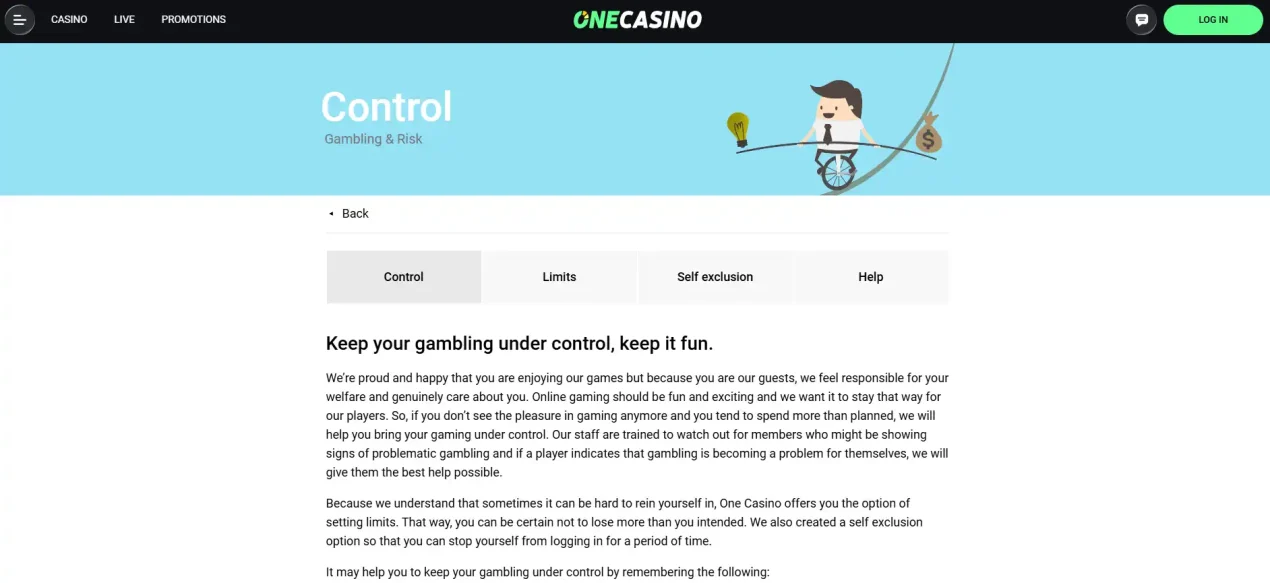
Contents
OneCasino uses a personal account rather than a guest checkout model. Its account terms connect a username and email address to identity and age checks, payment details and the rules on withdrawals. These are related controls, but they serve different purposes. A password protects access, an identity document links an account to a person, and a payment check establishes that the financial route belongs to that person. Passing one check is not a substitute for the others.
The practical account picture includes controls over money and session time, optional authentication codes and several customer-support routes. The casino’s browser catalogue works on mobile and desktop, while account ownership and verification obligations continue across both. Payment ownership is covered more broadly in the card and bank overview; the steps affecting a completed withdrawal are examined separately in withdrawal handling.
Limits that change how an account can be used
OneCasino describes four forms of responsible-play limits: deposits, wagers, losses and session time. Each measures a different part of activity. The amount paid into an account is not equal to the amount staked, because funds can be used for repeated rounds. Similarly, the result of a session can diverge sharply from the original deposit: wins can be staked again, and losses can accumulate while the same balance is repeatedly turned over. Treating those measures as interchangeable leaves gaps in personal safeguards.
A deposit limit constrains additional money put into the account. A wager limit deals with turnover across repeated stakes, including money previously won. A loss limit concerns a decline in funds through play, while a session-time limit adds a boundary that is independent of money. These distinctions are particularly relevant where a quick sequence of slot spins produces many betting decisions in a short period. None of the settings changes the mathematical risk of the underlying game.
| Control | What it constrains | Why it matters |
|---|---|---|
| Deposit | Funding the account | Separates new money committed from activity already funded. |
| Wager | Aggregate stakes | Accounts for balances used across multiple betting rounds. |
| Loss | Amount lost through play | Tracks an outcome rather than the gross stake amount. |
| Session time | Length of play | Addresses duration even when results fluctuate. |
OneCasino’s responsible-gaming information also describes self-exclusion and a cooling-off period. Increases to restrictions are subject to a seven-day cooling-off period under the operator’s stated process. This delay distinguishes loosening a boundary from simply setting one: without a pause, a limit can become ineffective at the very moment that activity becomes difficult to control. The precise controls need to be read in conjunction with the settings of the individual account rather than assumed to provide an automatic spending plan.
For a reader comparing casino features, the relevant distinction is between money, duration and access. Account limits can reduce exposure or interrupt use, but they do not turn gambling into a savings method or remove the possibility of losing the money already staked. New Zealand’s Gambling Helpline, listed in the footer, offers independent confidential assistance separate from any operator-run account control.
Account ownership and login security
The OneCasino terms allow one personal account per person. The one-account rule matters beyond keeping login details tidy: an identity, payment method and gambling activity all have to remain associated with a consistent account holder. If an individual opens additional accounts, the terms provide for cancellation or voiding of bets in relevant circumstances. The policy means that separate browser sessions or devices should not be mistaken for permission to create separate customer identities.
A password protects ordinary access to the account. OneCasino also presents an optional authentication-code feature through SMS or email. This introduces another check alongside the password; it does not replace age or payment verification. Access to the email inbox or phone receiving the code is therefore part of the security model, and someone who loses access to that channel may need help recovering account access. The operator’s help centre and contact routes are relevant to access issues as well as financial questions.
Three account risks have different triggers and consequences:
- Credential loss: a password or contact-channel problem can interrupt sign-in and require an account-recovery process.
- Duplicate identity: a second account belonging to the same person can invoke the operator’s one-account rule even if the passwords and emails differ.
- Payment-name mismatch: account access may still work, but financial verification can pause if the named owner of a funding or return route does not match the account holder.
Those cases should not be treated as the same problem. Changing a password addresses a login issue; it does not resolve ownership of someone else’s payment account. Likewise, a working second email address does not make a duplicate account acceptable. The licence and NZ rules section covers the separate legal context; the personal-account controls described here apply to the casino’s account design, without implying that New Zealand registration is guaranteed.
Browser-based use on a phone and on a desktop does not alter that underlying arrangement. OneCasino’s catalogue operates without a mandatory game download, so the form factor changes while the account identity and terms remain attached to the same customer record. Device convenience should not be confused with anonymous play or reduced responsibility for security settings.
What identity and payment verification involve
OneCasino uses identity and age verification within its account process. Its terms and financial help material also describe checks of payment details and the possible request for documents in connection with a larger withdrawal. These procedures distinguish a casino account from a service that relies only on an email address. An entered birth date is personal information supplied at sign-up; it is not equivalent to completing an identification check that establishes who owns the account.
A withdrawal adds a practical reason for checking identity. Payment providers and banks handle money in the name of an identifiable owner. Where a customer deposits with a payment route and later requests a return, the operator’s process links the account holder to that route. An inconsistency can produce a further document request. This is why access credentials, identity documents and banking information need to be thought of as separate layers instead of a single step labelled “verification”.
- Age and identity: the operator’s personal-account records and submitted identification details concern who is using the service.
- Payment ownership: card, bank and other payment information concerns the owner of the money route, not simply which method appears in a cashier.
- Withdrawal review: a larger cashout can require supporting documents and account checks before a transfer is handled.
- Terms enforcement: false personal details, duplicate-account activity and anti-money-laundering concerns are among grounds addressed by the operator’s suspension and refusal clauses.
The presence of these checks is a material account condition, not evidence that one specific customer has failed them. OneCasino’s terms describe circumstances in which access or payments can be restricted. They should be understood as contractual powers with potential financial consequences, not as evidence that every review leads to refusal or a dispute. Withdrawal routing and processing are developed in the separate cashout analysis.
Verification and responsible-play measures serve distinct roles. Verification connects a real individual with an account and payment source. Deposit and loss controls limit aspects of activity by that individual. Both may affect the user experience, but neither establishes a game’s fairness or the outcome of future play. A completed identity check is an administrative event, not an assurance that funds at risk will be returned.
Registration details and everyday account use
The sign-up flow described by OneCasino requests a username or email, date of birth and password, with the account tied to one person. This structure creates an identifiable record from the start. The date of birth relates to age screening; the email and password support account communication and access. Those fields do not by themselves settle payment ownership or any subsequent request for identity documents. Describing the fields is different from confirming eligibility to sign up from every country.
After an account is created, the same credentials connect game history, account balances, settings and support enquiries. The browser site accommodates desktop and mobile screens, so a change of device does not create a separate account. A person using a shared device should recognise the difference between logging out of a browser session and closing an account entirely. The former ends a session; the latter belongs to the operator’s account processes and applicable terms.
The most useful way to understand the account lifecycle is to separate actions from checks:
- Profile details associate an email, username and birth date with one account holder.
- Access controls govern passwords and optional codes received through the linked email or phone.
- Funding details connect the account to a card or bank route whose ownership can be checked.
- Safer-play settings set boundaries for deposits, wagers, losses and sessions.
- Withdrawal review may call for additional checks of identity and payment information.
These are functional stages, not a promise of an automatic or instant approval sequence. OneCasino’s one-account requirement is continuous: the profile used for a payment and for an eventual dispute still belongs to the same person. The payments analysis explains how account funding differs from a settlement or bank charge, while the specific return route belongs to the withdrawal terms.
For mobile use, the main product is a browser experience. It accommodates the same account and the categories shown on the desktop site, including slots, live tables and the operator’s exclusive games. A smaller screen affects navigation and presentation, not the meaning of a wager, the one-account limit or the identity process. The catalogue overview explains the difference between game categories and individual game mathematics rather than treating the mobile layout as a different game product.
Support channels and resolving an account problem
OneCasino offers an on-site help centre, a contact form, [email protected] and a contact telephone number, +356 27782188, in its terms. Casino Guru also describes a 24/7 live-chat facility on the reviewed casino profile. The telephone number is an operator contact, not a New Zealand local helpline, and the third-party live-chat description should not be read as a guarantee of a particular response time or local staffing arrangement. English is among the support languages used by the product.
Support requests have different levels of specificity. A routine login question can often be expressed using the account email or user identifier; a payment question is better framed around a particular transaction and its method. An identity-review matter concerns the type of document requested and the account holder to whom it relates. None of these requires posting a password or authentication code in a public complaint or forwarding sensitive details to an unrelated address.
For an account-related support exchange, three pieces of context have practical value:
- The account issue: whether the difficulty concerns access, a restriction, funding or a withdrawal.
- Relevant transaction details: dates and payment references for the particular event, rather than guesses based on an overall balance.
- The response record: what the operator asked for, what was supplied through its appropriate channel and how the matter was answered.
Keeping the categories distinct makes a request understandable without confusing a password-reset problem with a contested transfer. A delayed withdrawal and an account closure are also different questions under the terms. The dedicated withdrawal section examines method returns, business-day handling and financial verification; this account section is concerned with the identity and access relationship behind them.
The contact channels are part of the operator’s own service. For gambling-related distress or difficulty controlling use, independent assistance is a different need. Gambling Helpline in New Zealand provides confidential support at 0800 654 655. Operator help can address account mechanics, but a support conversation does not substitute for financial boundaries or independent help with harmful gambling behaviour.
Questions about OneCasino accounts
Are multiple OneCasino accounts allowed?
No. OneCasino’s terms permit one personal account per person. Duplicate accounts can lead to cancellation or voided bets under its conditions.
Which responsible-play limits can users set?
OneCasino describes deposit, wager, loss and session-time limits, as well as self-exclusion and a cooling-off process for increases to restrictions.
Is identity verification part of the process?
Yes. Identity and age checks are part of the account process, with payment-detail verification and potential supporting documents for larger withdrawals.
Account controls affect both access and cashout
OneCasino’s account model combines a single personal identity, browser access, optional SMS or email codes and safeguards that cover both money and time spent gambling. Its identity checks and payment-holder rules explain why possession of login credentials is not enough to settle a withdrawal question. A casino balance, a wagering history and a payment route matched to the account holder are different pieces of the customer record, and each can matter when a transaction is reviewed.
The distinctive feature is this interaction between access and money handling. Self-imposed limits can constrain activity while the user still has account access; ownership and verification checks can affect a cashout even when gameplay has ended. Reading the one-account requirement, responsible-play settings and support routes together gives a more realistic account of the product than treating registration as a single form and every later transaction as automatic.
This material was created by the OneCasino Fieldnotes team.
Related posts

OneCasino withdrawals and payment checks

OneCasino payment methods and deposit handling